Each year, I pick the top 3 books I read, write a small reflection on each, and share them with my mailing list. I will leave links to prior years’ top 3 at the bottom of this post.
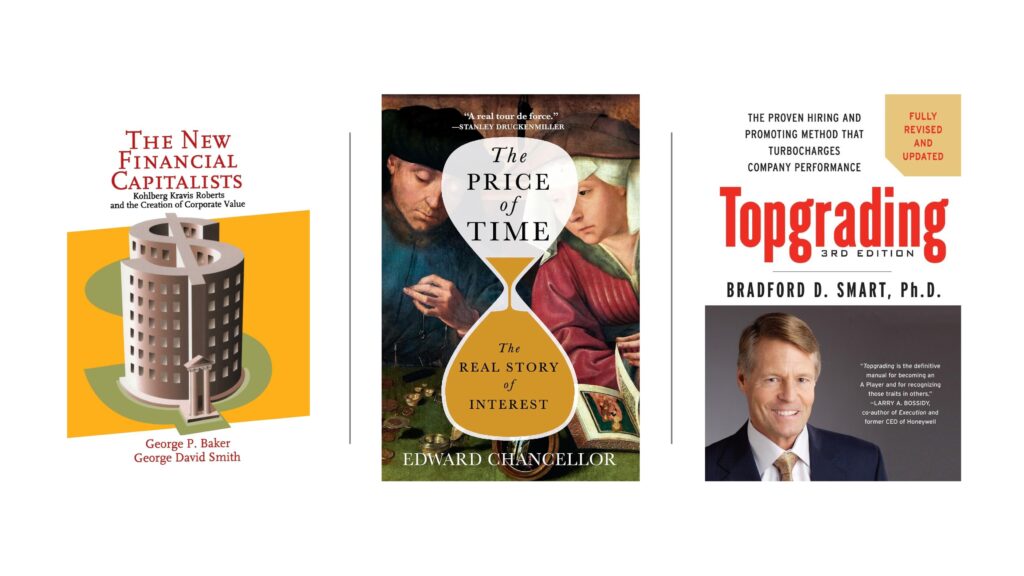
My top 3 book picks of 2025 (in no particular order) are as follows…
#1 – The New Financial Capitalists by George P. Baker & George David Smith
This book covers the history of the private equity industry, tracing its development from the postwar period through the rise of modern buyout firms. The book examines how private equity emerged as a distinct ownership model, focusing on governance, incentive alignment, and long-term capital stewardship, an alternative to existing models like publicly traded conglomerates. It profiles early firms (predominantly featuring KKR) and practitioners, explores how PE structures evolved.
Why I Liked It?
Most books and media coverage paint private equity in a negative light. This one is far more balanced, and in fact, probably a bit positive-leaning. The authors focus on the value private equity has created in corporate America, and why the PE model was far superior to the forms of ownership it replaced. The book gets into the mechanics of real transactions, including how deals were structured, capital was deployed, and returns were generated.
#2 – Topgrading by Bradford P. Smart
This book is about hiring and talent management built around the idea that organizations should strive to hire, retain, and promote only top performers. The book introduces the A Player, B Player, and C Player framework and lays out a structured approach to identifying high performers through rigorous screening, reference checks, and career-history analysis. It is widely used by CEOs and operators across a range of industries and emphasizes talent density, accountability, and the long-term organizational impact of hiring decisions.
Why I Liked It?
Hiring is one of the most important decisions in any organization, and also one of the areas where many people struggle the most; this book treats it with the rigor it deserves. The Topgrading framework is clearly articulated and hard to argue against. The book is highly practical, providing readers with a step-by-step guide to implementing the Topgrading method. Much of my recent thinking on talent, and my post Expensive Talent Is Cheap, was influenced by the ideas in this book.
#3 – The Price of Time by Edward Chancellor
The Price of Time is a history of interest rates and the role they play in economic systems. It traces their roots from the earliest recorded use of interest in ancient Mesopotamia, including the Code of Hammurabi, through to the modern central banking framework. The book examines how societies across history have priced time and risk through interest, and how that price has shaped capital allocation, credit cycles, and economic behavior. Chancellor combines financial history with economic theory to explore how prolonged periods of artificially low interest rates distort investment decisions, asset prices, and risk-taking, drawing clear connections between modern monetary policy and historical precedent.
Why I Liked It?
You can never read enough history, especially financial history. Interest rates have an immense impact, not just on the economy, but on society at large. So it’s good to get an understanding of how interest rates have evolved, and how we got to where we are today. It also highlights the absurdity of the modern central banking system and ultra-low interest rates (puts forth compelling arguments against both things).
I hope you enjoy reading these books as much as I did. My previous annual picks can be found here: 2024, 2023, 2022, 2021, 2020, 2019.